
Mexican Half and Half Tarantula
Psalmopoeus victori
Species Profile & Temperament

| Trait | Overview |
|---|---|
| Origin | Rainforest canopies of Veracruz, Mexico |
| Diet Type | Insectivore (Crickets, Roaches) |
| Activity | Nocturnal (Builds "dirt curtains" and tubular webs high up) |
| Temperament | Extremely fast, defensive, and flighty. |
| Handleability | Absolutely not. Do not handle this species under any circumstances. |
| Venom | Wash any bite that breaks the skin with soap and water. Ask your doctor about any health concerns. |
| Urticating Hairs | No (Which is why they are so defensive with their bite) |
| Difficulty | 4/5 — Advanced (Due to their speed and defensiveness) |
| Hardiness | 3/5 — Moderate (Requires good ventilation and moderate humidity) |
Safety Information (CRITICAL)

No Itchy Hairs: This spider has no urticating hairs. It defends itself by bolting or biting.

Bites: Wash any bite that breaks the skin with soap and water. Ask your doctor about any health concerns.
Defense: They are incredibly fast and prone to bolting. If cornered, they will readily throw up a threat pose and bite.
Handling Precautions: NEVER handle this spider. All feeding and maintenance should be done using long tongs. Keepers must always be aware of exactly where the spider is before opening the enclosure lid.

Housing & Enclosure
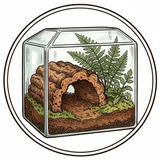
Enclosure Type & Size
- Type: Arboreal. The enclosure must be taller than it is wide.
- Minimum: A tall enclosure with side vents. Ask us in store for the right size for your spider.
- Ventilation: Excellent cross-ventilation is required to prevent mold and stagnant air.
- The Mesh Warning: If your enclosure has a wire mesh screen top, consider replacing it with drilled acrylic, as arboreal tarantulas can get their claws stuck in the mesh.
Substrate
- Recommended: Coconut fiber (Eco Earth) or organic topsoil.
- Depth: A layer on the floor. While they live in trees, this genus is famous for building "dirt curtains"—they will carry dirt up the glass to camouflage their web hammocks.
Décor & Enrichment
- Anchor Points (CRITICAL): You must provide a tall, vertical cork bark tube or curved piece of cork bark leaning against the glass. They will build a thick, silken tube behind it to hide in during the day.
- Water Dish: Provide a small water dish. If possible, glue or magnetize it to the side of the glass, as they prefer not to touch the ground.
Temperature
| Zone | Temperature |
|---|---|
| Ambient | Normal room temperature. No heat lamp. |
- Heating: Room temperature is usually fine, but they enjoy it slightly warmer. Never use a heat lamp. If necessary, use a small heat pad on the side of the glass, away from the web, on a thermostat.
Humidity
- Target Range: Slightly damp low down, drier up top.
- How to Maintain: Keep the lower layers of the substrate slightly damp (but not swampy). Ensure the top half of the enclosure remains relatively dry to prevent stagnant air.
Diet & Nutrition

They have an incredibly aggressive feeding response. They often dart out of their cork bark tube to snatch a cricket in mid-air.
Primary Diet
- Live crickets or dubia roaches.
Feeding Schedule
Young spiders eat more often than adults. Ask us in store for a feeding plan that fits your spider's size, and always remove uneaten live prey.
Molting
During the Molt
- DO NOT disturb or handle the spider. They will molt suspended in their web hammock.
- Remove any live crickets from the enclosure immediately.
Post-Molt Care
- Wait before offering food so their new fangs have time to harden.
What We Use & Recommend
These are products we use and recommend for this species. Stock varies by store, so ask us what we have in store today.
| Category | Product | Notes |
|---|---|---|
| Enclosure | Exo Terra 12x12x18 Glass Terrarium | Perfect arboreal size |
| Substrate | Zoo Med Eco Earth (Coco Fiber) | Needed so they can build their "dirt curtains" |
| Hides | Zoo Med Natural Cork Bark (Tall Tubes) | Absolutely essential for their webbing |
| Tools | Zoo Med 10-inch or 12-inch Feeding Tongs | Mandatory for safety when opening the tank |
| Water Dish | Magnaturals Magnetic Water Dish | Allows you to put the water dish high up on the glass |
Last updated: 2026-08-04
How We Keep Them at Critter Cabana & Gresham Pet Supply
- Oregon Winter Furnace Air vs. Molting Humidity: When Pacific Northwest furnaces kick on from October through April, indoor room humidity drops fast and dries out small enclosures from the top down. Rather than misting the spider or invert directly (which stresses terrestrial species and invites stagnant mold), we keep Mexican Half and Half Tarantula with strong cross-ventilation and a water dish it can reach up high. The substrate is slightly damp low down and never soaked. We never mist the spider or its web.
- Safe Room Heating in the Willamette Valley: If your house gets cold on winter nights, never put a heat pad under the tank. Use a low-wattage side-mounted heat mat on a digital thermostat, away from the web, or keep the room at a comfortable room temperature.
- Shopping at Newberg & Gresham: For enclosures, cork bark, substrates, springtails and feeders at Critter Cabana (Newberg) and Gresham Pet Supply, ask us what we have in store today.
Common Questions (FAQ)
How do I keep my Mexican Half and Half Tarantula warm and humid enough during an Oregon winter?
Keep your spider at a comfortable room temperature with no heat lamp. Keep strong cross-ventilation, a water dish up high, and the substrate slightly damp low down but never soaked. Never mist the spider or its web. Never put a heat mat underneath the enclosure. Ask us in store for the right setup for your spider.
What size enclosure does a Mexican Half and Half Tarantula need?
An adult Mexican Half and Half Tarantula needs a tall, cross-ventilated enclosure. Ask us in store for the right size for your spider. For terrestrial tarantulas and scorpions, floor space and deep substrate matter most (keep open fall height low so a fall cannot hurt your spider); for arboreal species, prioritize vertical cork bark tubes and cross-ventilation.
Can I put isopods in a Mexican Half and Half Tarantula bioactive enclosure?
Around molting tarantulas and scorpions, skip big, hungry isopods and stick to springtails, so a soft, newly molted animal is never nibbled.
Where can I find Mexican Half and Half Tarantula, cork bark, and feeder insects in Oregon?
Ask us what we have in store today at our two exotic animal stores: Critter Cabana in Newberg (514 E First St, 503-537-2887) and Gresham Pet Supply (2185 NW Burnside Rd, 503-665-7606).
Shop supplies for this animal
Everything for your Mexican Half and Half Tarantula setup, ready for pickup in store or shipped to you.