
Syrian Hamster
Mesocricetus auratus

1. Deep-Burrowing Terrarium & Solid Wheel Setup
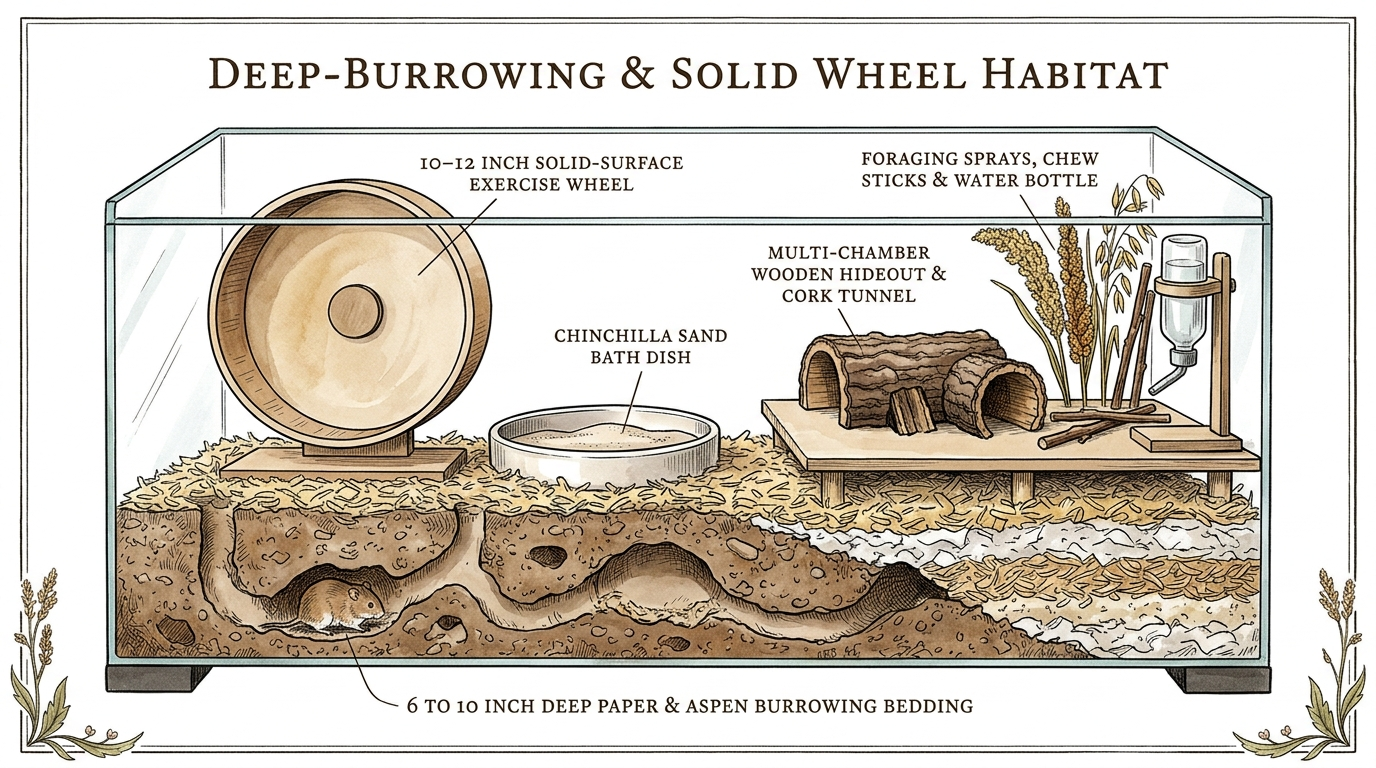

2. Two Great Ways to Set Up Your Habitat
Enclosure: Large Glass Tank vs. Modular Plastic Tube Cages
Skip tiny colorful tube cages! Their floor space is small, they cannot hold deep bedding, and cause hamsters to chew bars all night:
Option A: Large Glass Breeder Tank + Locking Screen Lid (Our Top Pick!)
Gives a big unbroken floor, holds deep burrowing bedding without kicking it onto your floor, and fits a big solid wheel easily! Follow the maker's label; bigger is better.
Option B: Large Deep-Base Front-Opening Terrarium
Zero wire bars to chew (preventing broken teeth and nose rubs) with crystal-clear viewing of their underground tunnel system.
Burrowing Bedding Mix & Chinchilla Sand Bath
Never bathe a hamster in water! Water strips their protective coat oils, so give a sand bath instead:
Option A: Carefresh / Clean & Cozy Paper + Aspen Shavings + Orchard Hay
Layering soft paper bedding with dust-extracted aspen and a handful of soft hay acts like 'rebar' so their underground bedrooms never collapse!
Option B: Permanent Ceramic Chinchilla Sand Bath Dish
Fill a heavy ceramic dish with Reptisand or Chinchilla Bath Sand (use sand, not fine airborne dust!). They roll in it nightly to stay clean and often use it as a litter box!
The Solid Wheel & Solitary Housing Rule
Syrian hamsters are fiercely territorial desert loners:
Option A: Solid-Surface Upright Wheel (Silent Spinner / Niteangel Style)
A wheel that's too small forces a Syrian to arch its back. Always pick a solid-surface upright wheel big enough that the back stays straight (never wire mesh!).
Option B: Strictly One Hamster Per Enclosure
Housing two Syrian hamsters together leads to fights—even littermates. One hamster per tank is the golden rule.

3. Omnivore Foraging Diet & Hoard Management
Scatter-Feeding & Cheek Pouch Rules:
Sprinkle some of their food across the bedding so they forage
Stashing food in their bed is normal! Only remove wet/spoiled fresh food
Tuck millet, oat, and flax sprays into the bedding
Citrus, onion, garlic, chocolate, almonds, or sticky sugary treats

4. Four Keys to a Happy, Thriving Syrian Hamster
Let Sleeping Hamsters Sleep
Syrians sleep deeply all day and wake up around dusk. Waking a sleeping hamster startles them and is the #1 cause of defensive nips—wait until they're up and exploring in the evening!
Spot-Clean, Don't Strip-Clean!
Replacing all the bedding at once erases their scent marks and stresses them out! Spot-clean the pee corner every day. When the bedding needs freshening, change some and mix clean old bedding back in; do a full change only if it's soiled through, after sickness, or after a move.
Skip Exercise Balls & Cotton Fluff
Plastic run-about balls have poor ventilation, trap toes in air slits, and blind a hamster's whiskers. Also skip 'fluffy cotton' nesting material, which tangles around legs and pouches.
Keep the Room Steady
Keep their room at a steady temperature, away from cold drafts and direct sun. A hamster that seems limp, cold, or barely breathing needs a vet right away, ideally one who treats exotic animals.

Bring-Home Shopping Checklist
Tap items to check them off on your phone while you shop at Gresham Pet Supply.
Large Tank & Deep Bedding
Solid Wheel, Sand Bath & Chews
Food & Hydration
Complete Reference Notes & Oregon Keeping Guide
Notable Breeds & Varieties
All domestic Syrian hamsters are exactly the same species, but they are often sold under confusing marketing names based on their fur type:
- "Teddy Bear" Hamster: This is just a long-haired Syrian hamster. Males get spectacular "skirts" of long fur, while females usually just look slightly fluffy.
- "Black Bear" Hamster: A marketing term for a solid black, short-haired Syrian.
- Short-Haired / Golden: The standard, wild-type fur coat.
Housing & Enclosure
Enclosure Size (The Space Warning)
- Size: A large, secure habitat with a big continuous floor. Follow the habitat maker's label; bigger is better.
- Female Syrians: Females often want more room, so if you're buying a female, plan on an even larger enclosure (like a bigger tank or a large DIY bin cage).
- Enclosure Recommendations: Do not use small, modular plastic tube cages (like CritterTrails). Syrian hamsters can get stuck in the tubes, and the floor space is small.
Bedding & Substrate
- Depth (CRITICAL): Hamsters are burrowing animals. Provide bedding deep enough to burrow so they can build tunnel systems.
- Recommended: Unscented paper bedding (Carefresh, Kaytee Clean & Cozy) or Aspen shavings.
- Avoid: Cedar shavings, pine shavings, and anything scented.
- Cleaning Schedule: Spot clean the soiled corner (they usually pick one corner to pee in) every day. When the bedding needs freshening, do a partial change and mix some clean old bedding back in so it still smells like home. Do a full change only when the bedding is soiled through, after the hamster has been sick, or after a move.
Décor & Enrichment
- The Wheel (CRITICAL): A Syrian hamster needs a solid-surface wheel big enough that their back stays straight while running (size it by the wheel's label). Never use wire or mesh wheels, which can catch their feet.
- Hideouts/Huts: Provide large wooden houses or multi-chamber hides.
- Sand Bath: Provide a large dish filled with ReptiSand (pure quartz desert sand without calcium or dyes) for them to clean their fur. Do not use chinchilla dust.
Diet & Nutrition
Fresh vegetables are a small daily extra, and fruit is a small treat.
Primary Diet
- Pellet or Lab Block First: Make a uniform hamster pellet or lab block the base of the diet. A seed and grain mix can be added as an optional extra.
- Feeding Amount: Follow the food's label. Scatter-feed some of the food by sprinkling it around the cage to encourage natural foraging.
Fresh Vegetables & Fruits
- Safe Veggies: Broccoli, cucumber, zucchini, spinach, carrots, and sweet potato.
- Safe Fruits (Treats): Apples (no seeds), bananas, blueberries, and strawberries.
- Frequency: Small pieces only. Remove what isn't eaten before it spoils, since hamsters hoard food in their nests.
Treats
- Safe Treats: Mealworms (dried or live) or plain unflavored oats, in moderation.
Handling & Behavior
Taming & Handling
- Always wash your hands before handling; if you smell like food, they may give you a test nibble.
- Never wake a sleeping hamster. If you dig them out of their burrow during the day, they will likely bite you out of fear. Wait until they wake up in the evening.
Social Needs (The Solitary Rule)
- Strictly Solitary: Syrian hamsters are fiercely territorial. If you put two Syrian hamsters in the same cage, they will fight. They do not get lonely. They must live alone.
Health & Husbandry

Common Health Issues
- Wet Tail — Symptoms: Severe, watery diarrhea, lethargy, hunched posture, and a wet/soiled tail. / What to do: This is a sign your hamster is sick. See your vet today, ideally one who treats exotic animals.
- Overgrown Teeth — Symptoms: Inability to eat, drooling. / Cause: Lack of wooden chew toys. / Treatment: Requires a vet to trim the teeth.
- Mites — Symptoms: Intense scratching, thinning fur. / Cause: Often brought in on cheap bedding or hay. / Treatment: See your vet, ideally one who treats exotic animals.
What We Stock & Use in Our Stores
These are products we carry and recommend for this species. Ask any associate for help finding them in-store.
| Category | Product | Notes |
|---|---|---|
| Enclosure | Aqueon 40-Gallon Breeder Aquarium + Screen Lid | A big continuous floor; follow the maker's label, bigger is better |
| Bedding | Carefresh Unscented Paper Bedding | Holds burrows well. Fill it deep enough to burrow! |
| Food | Higgins Sunburst Gourmet Blend + Mazuri Rat & Mouse Diet | Lab block as the base; the seed mix is an optional extra |
| Wheel | Exotic Nutrition Silent Runner (12-inch) | Solid surface; pick a size big enough that their back stays straight |
| Sand Bath | Zoo Med ReptiSand (Natural Red or White) | Safe, dust-free sand for bathing. Never use calcium sand. |
| Chew Toys | Oxbow Enriched Life Apple Sticks & Willow Balls | Essential for keeping front teeth trimmed |
Last updated: 2026-08-04
How We Keep Them at Critter Cabana & Gresham Pet Supply
- Pacific Northwest Seasonal Drafts & Indoor Air Quality: In Oregon, damp chilly winters and sudden August heatwaves are the two biggest environmental stressors for Syrian Hamster. Keep their habitat away from drafty windows, exterior doors, direct furnace vents and direct sun, at a steady room temperature. For size, follow the habitat maker's label; bigger is better.
- What Our Store Crew Uses Daily: In our Newberg and Gresham animal rooms, we use dust-extracted, scent-free bedding (never cedar or raw phenols), a hamster pellet or lab block as the base diet, scatter-fed so they forage, and daily burrowing and chewing enrichment so young animals are already hand-accustomed and eating a balanced diet before they go home with you.
- Local Exotic Vet Planning: Before an emergency ever happens, save the number of an experienced Oregon avian/exotic veterinarian in the Portland Metro or Willamette Valley area (such as Avian & Exotic Veterinary Care or Scales & Tails Exotic Pet Clinic).
Common Questions (FAQ)
What size cage or habitat does a Syrian Hamster actually need?
A large, secure habitat with a big continuous floor and bedding deep enough to burrow. Follow the habitat maker's label; bigger is better, and females often want more room. Ask our staff to help you pick one.
How do I keep Syrian Hamster comfortable through Oregon winters and summers?
Keep them at a steady room temperature, away from drafts and direct sun: well away from cold window drafts in winter and direct afternoon sun in summer. If you're unsure about a room, ask our staff.
What do you feed Syrian Hamster at Critter Cabana and Gresham Pet Supply?
Our store crew feeds a balanced omnivore regimen built on a hamster pellet or lab block, with small amounts of fresh veggies and fruit as a small treat. A seed mix is only an optional extra, never the whole diet.
Where can I meet Syrian Hamster and talk to the animal care crew in Oregon?
Visit our live animal departments at Critter Cabana in Newberg (514 E First St, 503-537-2887) or Gresham Pet Supply (2185 NW Burnside Rd, 503-665-7606) to meet our animals and get hands-on setup advice.
Shop supplies for this animal
Everything for your Syrian Hamster setup, ready for pickup in store or shipped to you.