Kenyan Sand Boa
Eryx colubrinus
Species Profile & Temperament

| Trait | Overview |
|---|---|
| Origin | East Africa (Kenya, Egypt, Sudan, Tanzania) in arid, sandy regions |
| Diet Type | Carnivore (Frozen/Thawed Mice) |
| Activity | Nocturnal / Crepuscular (active at night or dusk, mostly stays buried) |
| Temperament | Incredibly docile, slow-moving, and easy to handle. |
| Handleability | Excellent. They do not wrap around your arm like pythons; they prefer to simply rest in the palm of your hand. |
| Social Needs | Strictly solitary. Keep one per enclosure to avoid stress. |
| Difficulty | 1/5 — Beginner (One of the absolute easiest pet snakes available) |
| Hardiness | 4/5 — Hardy (Tolerates handling well and forgives minor temperature drops) |
Notable Morphs & Locales

While the wild-type features a bright orange/yellow background with dark brown/black splotches, several beautiful morphs are popular in the hobby:
- Dodoma: A naturally occurring locale (from the Dodoma region of Tanzania) featuring high-contrast orange and black, often with a reduced or circular pattern rather than messy splotches.
- Albino: Lacks all dark melanin, resulting in a bright yellow, orange, and white snake.
- Anerythristic (Anery): Lacks red/yellow pigment, creating a high-contrast black, gray, and white snake (looks like a cookies-and-cream pattern).
- Snow: A combination of Albino and Anery, resulting in an almost completely white or pale pink snake.
- Paradox: A snake that randomly expresses patches of color that shouldn't be there (e.g., an Albino snake with random, distinct black spots).
Housing & Enclosure
Enclosure Size
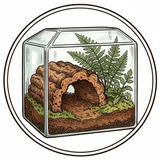
Because of their extreme sexual dimorphism (females are massively larger than males), enclosure requirements differ based on sex:
- Plan by sex: A female needs a bigger enclosure than a male. Floor space matters more than height. Ask our staff to help you choose.
- Style: Glass terrarium with front-opening doors or a very secure screen lid. Warning: Sand Boas are incredibly strong for their size and will easily push open an unclipped screen lid while exploring the edges of the tank.
Enclosure Setup
- Substrate: Deep substrate is the most important part of their care. They are fossorial (burrowing) snakes. Provide loose bedding deep enough for the snake to bury itself completely. Aspen bedding holds tunnels well and stays dry. Ask our staff before choosing any sand or soil mix. Avoid calcium sand.
- Decor: They don't need climbing branches because they cannot climb well. Instead, provide ground clutter like cork bark flats, fake plants, and low, heavy hides that they can burrow underneath.
Humidity & Water
- Humidity: Low/Arid. Normal household humidity is usually perfect. High humidity will cause respiratory infections and blister disease.
- Humid Hide: During shedding, provide a small, enclosed hide filled with slightly damp sphagnum moss to help them shed their skin cleanly.
- Water Source: Provide a small, shallow water dish. If the dish is too large, the snake may spill it and ruin the dry substrate.
Temperature & Lighting
- Warm Side / Basking Spot: Follow the label on your heat mat, thermostat and thermometer. Since they burrow, an under-tank heat mat (regulated by a thermostat) is often preferred, but an overhead halogen bulb also works well.
- Cool Side: Keep one end cooler so the snake can move between warm and cool.
- Lighting: Provide a regular day and night light cycle. UVB is optional.
Diet & Nutrition
Primary Diet
- Food Type: Frozen/Thawed mice. Never feed live rodents. Sand Boas are ambush predators; they will often strike from underneath the substrate and drag the mouse down.
- Prey Size: The mouse should be no wider than the girth of your snake. If you're between sizes, go smaller. Adult males will eat "hoppers" or small adult mice, while adult females can eat large adult mice.
- Feeding Frequency:
- Ask our staff for the feeding schedule we use. Males stay small and are easy to overfeed, so don't feed more often than that schedule.
Socialization & Behavior
Handling
- Taming: Sand Boas are incredibly easy to handle. They rarely strike out of anger. If they are scared, they typically try to slither backward or jerk away rather than bite.
- Support: Because they are not arboreal, they do not know how to wrap around your wrist to hold on. You must support their heavy bodies completely in the palm of your hand, or they will simply fall off.
- Post-Feeding: Do not handle for 48 hours after feeding to prevent regurgitation.
Health & Husbandry

Common Health Issues
- Scale Rot / Blister Disease — Symptoms: Brown, crusty, or blistered scales on the belly. / Cause: Sitting in wet, dirty substrate or high ambient humidity. / Treatment: Keep the bedding dry and see a vet who sees reptiles.
- Obesity — Symptoms: Folds of fat, scale separation showing skin underneath, lethargy. / Cause: Overfeeding (especially with males). / Prevention: Don't feed adult males more often than the schedule our staff gives you.
- Stuck Shed — Symptoms: Retained skin on the tail tip. / Cause: Lack of a humid microclimate when shedding. / Prevention: Provide a humid hide when the snake goes into "blue" (cloudy eyes).
What We Stock & Use in Our Stores

These are products we actively carry and recommend for Kenyan Sand Boa setups. Ask any associate for help finding them in-store.
| Category | Product | Notes |
|---|---|---|
| Enclosure | Exo Terra Natural Terrarium (Low) | Floor space for burrowing. Ask our staff about size for a male or female |
| Substrate | Zilla Snake & Lizard Litter (Aspen) | Holds tunnels extremely well and stays dry |
| Heating | Zilla Heat Mat + Zilla Terrarium Heat & Habitat Controller | CRITICAL: Always use a thermostat to prevent burns |
| Hides | Zilla Rock Lair | A fantastic, heavy humid hide for shedding |
| Lighting | Exo Terra Reptile UVB100 | Optional low-output UVB |
| Water Dish | Exo Terra Water Dish (Small or Medium) | Small enough to prevent spills |
| Water Treatment | Zoo Med ReptiSafe Water Conditioner | Removes chlorine from tap water |
Last updated: 2026-08-04
How We Keep Them at Critter Cabana & Gresham Pet Supply
- Beating Dry Oregon Furnace Air (and Summer Heat Spikes): Across the Willamette Valley and Portland Metro, running the house furnace all winter drops indoor humidity to 25–35%, which quickly causes stuck sheds and dehydration in screen-top tanks. To keep Kenyan Sand Boa bedding dry, our crew uses loose, dry burrowing bedding and a small humid hide with damp sphagnum moss for shedding.
- Thermostat & Linear UVB Standard: Every heating element in our Newberg and Gresham reptile rooms runs on a thermostat probe set for a warm end and a cooler end, paired with a regular day and night light cycle. In summer, if an upstairs room climbs above 82°F, a dimming thermostat automatically backs down the basking lamp so the cool side never overheats.
- Shopping at Newberg & Gresham: For enclosures, thermostats, UVB lighting, bioactive supplies, springtails, isopods and feeders at Critter Cabana (Newberg) and Gresham Pet Supply, ask us what we have in store today.
Common Questions (FAQ)
What size tank does an adult Kenyan Sand Boa actually need?
Plan by sex: a female needs a bigger enclosure than a male. Floor space matters more than height, and you need room for a warm end and a cool end. Ask our staff to help you choose.
Is dry Oregon winter air a problem for a Kenyan Sand Boa?
Usually not. Sand boas want a dry enclosure, so skip moisture-holding soil mixes and screen covers. Give them a small humid hide with damp sphagnum moss so sheds come off in one piece.
What is the best bioactive clean-up crew for a Kenyan Sand Boa?
Sand boas want a dry enclosure, so a moist soil bed is the wrong setup. Ask our reptile staff before choosing any sand or soil mix or adding a clean-up crew. Our 1-Page or Tri-Fold Bioactive Substrate Recipe Guide covers the rest.
Where can I get Kenyan Sand Boa setup supplies, live feeders, and thermostats in Oregon?
Ask us what we have in store today at Critter Cabana in Newberg (514 E First St, 503-537-2887) and Gresham Pet Supply (2185 NW Burnside Rd, 503-665-7606).
Shop supplies for this animal
Everything for your Kenyan Sand Boa setup, ready for pickup in store or shipped to you.