
Isopods (Roly-Polys / Woodlice)
Various (Porcellio, Armadillidium, Trichorhina)
Species Profile & Temperament

| Trait | Overview |
|---|---|
| Origin | Found worldwide under logs and leaf litter |
| Diet Type | Detritivore (Eats leaf litter, decaying wood, feces, and protein) |
| Activity | Primarily nocturnal, though large species will forage during the day. |
| Temperament | Gentle with people. Hungry large isopods can nibble molting inverts or small, delicate animals. |
| Venom | None |
| Difficulty | 1/5 — Beginner (Very easy to breed and maintain) |
| Hardiness | 5/5 — Bulletproof (As long as they have a moisture gradient) |
The Golden Rule of Isopods
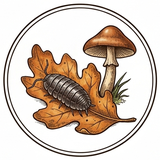
THE MOISTURE GRADIENT: Isopods breathe through modified gills. If they get too dry, they suffocate. If they get too wet, they drown. The absolute golden rule of keeping isopods is to provide a Moisture Gradient. One side of their enclosure must be damp (watered regularly), and the other side must be kept completely dry. This allows them to walk back and forth to regulate their own moisture needs perfectly.

Picking an Isopod Kind
There are many kinds of isopods. Some like it damp and some handle a drier tank, and big, hungry kinds can nibble a molting tarantula, scorpion or millipede. We'll help you pick an isopod kind that suits your tank's climate. Pick one isopod kind per build.
Culturing Isopods (How to breed them)
If you want to keep a "master culture" of isopods to continually harvest and seed multiple tanks, follow this setup:
Enclosure & Substrate
- Container: A small plastic "shoebox" bin. Drill small holes in the lid and sides for ventilation.
- Substrate: Mix organic topsoil, coconut fiber, and sphagnum moss. Make it deep enough for them to burrow. Ask our team for the depth.
- Leaf Litter (CRITICAL): Leaves are the primary food source for isopods. Cover the entire surface of the dirt with a thick layer of oak or magnolia leaf litter.
- Hides: Place a piece of cork bark on the dry side, and a piece of cork bark on the wet side.
Managing the Moisture Gradient
- Pour dechlorinated or RO/DI water onto the moss/dirt on exactly one half of the bin. Never spray the other half. When the wet side starts to dry out, pour a bit more water on it.
Diet & Nutrition (For Master Cultures)
In a bioactive terrarium, isopods will just eat reptile feces and leaf litter. However, in a master breeding culture, you need to supplement them to make the population explode.
- Base Diet: Leaf litter and decaying wood (Cork bark or rotted oak). They will eat this constantly.
- Protein Supplement: Now and then, drop in a small pinch of protein food. Feed only what they clear quickly. Leftover food grows mold and draws mites.
- Calcium Supplement: Isopods need calcium to build their shells. Always keep a piece of Cuttlebone in the bin for them to nibble on.
Seeding a Bioactive Terrarium
- Add Leaf Litter: Isopods will die in a bioactive tank if there is no leaf litter for them to eat and hide under.
- Wait to add your pet: Add your springtails and isopods and let the terrarium settle before you add your reptile. Ask us how long to wait. Longer is fine; sooner is not. This gives them time to burrow, find the damp spots, and establish a population before a giant lizard starts stomping on them.
- Pair with Springtails: Most builds want both. Isopods break down the big waste; springtails control mold and fungus.
What We Use & Recommend

These are products we use and recommend for this species. Stock varies by store, so ask us what we have in store today.
| Category | Product | Notes |
|---|---|---|
| Clean-up Crew | Springtails | Always pair isopods with springtails! |
| Leaf Litter & Wood | California Vivarium Supply (CVS) Black Oak Leaves (#306646) & Rotting Hardwood (#879112) | 100% mandatory base diet & shelter |
| Calcium | Zoo Med Cuttlebone | Drop a small piece in the culture so they can build their shells |
| Supplemental Diet & Dishes | Foxwood Fauna Pod Sprinkles, 3D Food Bowls & CVS Springtail Dust | Feed a tiny pinch in a dry dish, only what they clear |
| Substrate | The Bio Dude Terra Flora / Terra Fauna | Excellent substrates that hold moisture gradients perfectly |
Last updated: 2026-08-04
How We Keep Them at Critter Cabana & Gresham Pet Supply
- The Moisture Gradient in a Dry Oregon Winter: When Pacific Northwest furnaces kick on from October through April, indoor air dries out fast. We keep one side of each isopod bin damp and the other side drier, so they can move to the moisture they need. We wet the damp side with RO/DI water and keep a thick layer of leaf litter on top.
- Room Temperature: Isopods do well at ordinary room temperature and need no heat mat. Keep bins away from heaters and hot windows.
- Shopping at Newberg & Gresham: For enclosures, cork bark, substrates, springtails and feeders at Critter Cabana (Newberg) and Gresham Pet Supply, ask us what we have in store today.
Common Questions (FAQ)
How do I keep my Isopods (Roly-Polys / Woodlice) warm and humid enough during an Oregon winter?
Keep one side of the bin damp and the other side drier, and keep leaf litter on top. Ordinary room temperature is fine. When the damp side starts to dry, add a little more water to that side only.
What size enclosure does a Isopods (Roly-Polys / Woodlice) need?
A small plastic bin with air holes works for a culture. In a bioactive tank, they live in the soil and leaf litter. Ask us what size fits the colony you want.
Can I add isopods to my pet's bioactive enclosure?
Yes, as the cleanup crew. Pick a kind that suits the tank's climate. Don't put big, hungry isopods in with a molting tarantula, scorpion or millipede, or with small, delicate animals. Most builds also want springtails.
Where can I find Isopods (Roly-Polys / Woodlice), cork bark, and feeder insects in Oregon?
Ask us what we have in store today at our two exotic animal stores: Critter Cabana in Newberg (514 E First St, 503-537-2887) and Gresham Pet Supply (2185 NW Burnside Rd, 503-665-7606).
Shop supplies for this animal
Everything for your Isopods (Roly-Polys / Woodlice) setup, ready for pickup in store or shipped to you.