Hermit Crab
Coenobita clypeatus
Species Profile & Temperament

| Trait | Overview |
|---|---|
| Origin | Coastal regions and forests of the Caribbean |
| Diet Type | Omnivore / Scavenger (High protein, calcium, fruits, leaf litter) |
| Activity | Nocturnal (Most active at night, sleeping in piles during the day) |
| Temperament | Peaceful, highly social scavengers. |
| Handleability | Poor. While they can be handled, doing so causes them immense stress and removes them from their critical high-humidity environment. They are "look but don't touch" pets. |
| Difficulty | 2/5 — Easy (But requires a very specific enclosure setup) |
| Hardiness | 3/5 — Moderate (Requires strict humidity and proper molting conditions) |
The Humidity Warning (CRITICAL)

MODIFIED GILLS: Hermit Crabs do not have lungs. They breathe through modified gills. If the air in their tank gets too dry, their gills dry out and they slowly suffocate. You must keep the air humid at all times using a solid lid (glass or plastic, not a screen). Use a hygrometer, and ask our team for the humidity range to aim for.

The Social Rule
NEVER ALONE: Hermit Crabs are highly gregarious and live in massive colonies in the wild, often traveling in packs to find food and trade shells. They do better with other hermit crabs. Every crab in the tank must be the same species. Never mix species.
Housing & Enclosure
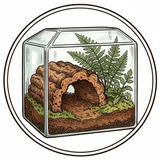
Tank Size & Environment
- Size: Size the tank for the group, with plenty of floor space to molt and roam. Ask our team for the right size. A small plastic carrier with a little gravel is not a home.
- Lid: A solid glass or plexiglass lid is required to trap humidity.
- Heat: Use a reptile heat mat (UTH). Place it on the BACK wall of the tank above the substrate line, NEVER on the bottom. (A crab buried to molt cannot get away from heat below). Run every heat source on a thermostat, and ask our team for the temperature range to aim for.
Substrate (The Molting Requirement)
- Crabs must shed their exoskeleton to grow (molting). To do this safely, they bury themselves deep in the dirt for weeks or months.
- Substrate Depth: At least 6 inches deep, or 3 times the height of your largest crab, whichever is deeper, so every crab can bury itself completely.
- The Mix: About 5 parts play sand to 1 part coconut fiber (such as Zoo Med Eco Earth). Moisten it with dechlorinated water until it holds a burrow, like "sandcastle sand." Don't use calcium sand or reptile sand.
- NEVER DIG THEM UP: If a crab buries itself, it is molting. Digging it up will kill it.
Enrichment & Shells
- Provide climbing branches (cholla wood, cork bark).
- Shells: Always provide spare natural shells in a few sizes a little bigger than each crab's current shell, so they can move up and don't fight over one. Use natural shells with circular or D-shaped openings (Turbo shells are their favorite). Choose natural, unpainted shells.
Diet & Water

Water (Two Pools Required)
Hermit crabs require access to two different water sources at all times:
- Freshwater Pool: Treated with a tap-water conditioner (like Seachem Prime) to remove toxic chlorine.
- Saltwater Pool: Mixed with marine-grade aquarium salt (like Instant Ocean). Never use table salt.
- Both pools must be deep enough for the crabs to fully submerge themselves, but include a ramp or plastic mesh so they can easily climb out and not drown.
The Diet
- Staple Diet: Feed a hermit crab food as its label says. Ask our team about any extras.
- Calcium: Always provide a piece of cuttlebone or crushed oyster shell for exoskeleton health.
- Leaf Litter: Dried oak or Indian almond leaves should be scattered on the floor for them to munch on.
What We Use & Recommend

| Category | Product | Notes |
|---|---|---|
| Housing | Glass Tank + Solid Glass Lid | Size it for the group; the lid traps humidity |
| Substrate | Plain play sand + Zoo Med Eco Earth | About 5 parts sand to 1 part coco fiber, damp, at least 6 in deep |
| Diet | Zoo Med Hermit Crab Salt / Cuttlebone | Essential for marine pools and calcium |
| Decor | Zoo Med Cork Bark / Cholla Wood | Essential climbing enrichment |
Last updated: 2026-08-04
How We Keep Them at Critter Cabana & Gresham Pet Supply
- Humid Air in a Dry Oregon Winter: When Pacific Northwest furnaces kick on from October through April, indoor air dries out fast. Hermit crabs breathe through modified gills and need humid air all year. Use a solid lid, deep damp sand and coconut fiber, and both a fresh and a salt water pool. Mist the walls and decor with RO/DI water, never the crabs.
- Safe Room Heating in the Willamette Valley: Never put a heat pad under the substrate. A crab that buries itself to molt cannot get away from heat below. Mount heat on the side or back wall, on a thermostat, and ask us for the temperature range to aim for.
- Shopping at Newberg & Gresham: For enclosures, cork bark, substrates, springtails and feeders at Critter Cabana (Newberg) and Gresham Pet Supply, ask us what we have in store today.
Common Questions (FAQ)
How do I keep my Hermit Crab warm and humid enough during an Oregon winter?
Use a solid lid to hold humidity in, deep damp sand mixed with coconut fiber, and both a fresh and a salt water pool. Mount any heat on the side or back wall on a thermostat, never underneath. Use a thermometer and a hygrometer, and ask us for the exact temperature and humidity to aim for.
What size enclosure does a Hermit Crab need?
Size the tank for the group, with plenty of floor space to roam and room for deep substrate to molt in. It needs a solid, well-fitting lid. Ask us for the right size for your crabs.
Can I put isopods in a Hermit Crab bioactive enclosure?
Keep hermit crabs with their own species only. Never put them in with any other animal.
Can I get a Hermit Crab, cork bark, and feeder insects in Oregon?
Ask us. Hermit crabs are a special order that a manager approves. For cork bark, substrates and feeders, ask us what we have in store today at our two exotic animal stores: Critter Cabana in Newberg (514 E First St, 503-537-2887) and Gresham Pet Supply (2185 NW Burnside Rd, 503-665-7606).
Shop supplies for this animal
Everything for your Hermit Crab setup, ready for pickup in store or shipped to you.