
Hermann's Tortoise
Testudo hermanni
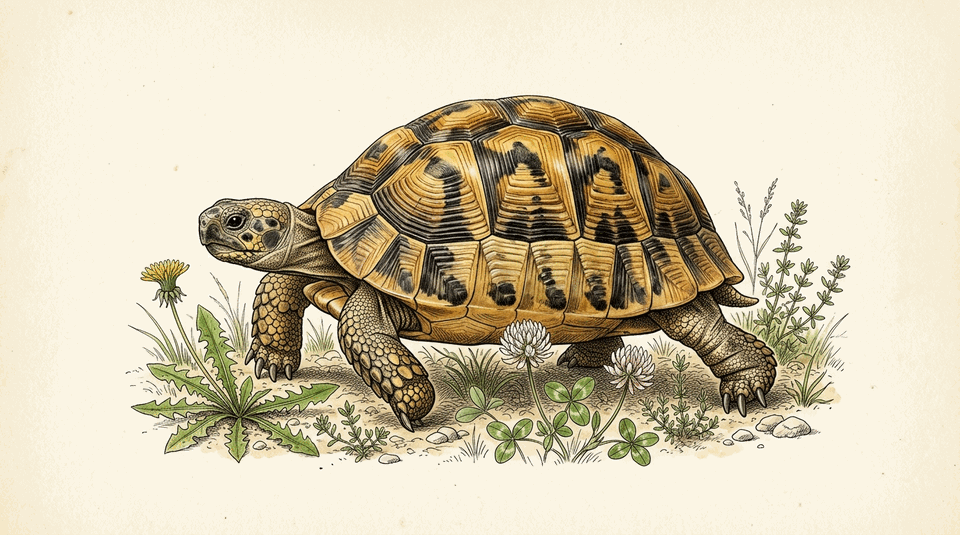
1. Wide Walking Space, Strong UVB & Damp Digging Dirt
2. Two Great Ways to Set Up Your Habitat
Enclosure: Wide Glass Tank Setup vs. Summer Garden Pen
Tortoises are marathon walkers—and if they can see through clear glass, they'll bonk their nose trying to walk through it all day:
Option A: 40-Gal Breeder, 50-Gal Low-Boy, or 36"×18" Terrarium (Our Top Pick)
Wide floor space gives them room to roam! Just tape a 5-inch strip of dark paper around the outside bottom rim so they don't pace the glass.
Option B: Predator-Proof Outdoor Summer Pen
On sunny Oregon/Washington summer days (70–85°F), a wire-topped garden pen with pesticide-free dandelions and shade bushes is paradise!
Bedding: Why We Ditch Bone-Dry Pellets!
Old books used to recommend dry rabbit pellets or sand—we now know bone-dry bedding is what causes bumpy 'pyramided' shells!
Option A: Reptisoil + Forest Floor Cypress / ReptiBark (4–5" Deep)
Holds gentle moisture underneath for burrowing while giving firm traction.
Option B: Reptisoil + Eco Earth + Flat Slate Dinner Tile
Always serve greens on a rough flat piece of slate rock—scraping salad off stone files their beak down naturally so it never overgrows!
Sunbeam Lighting: Linear T5 HO UVB + Basking Flood Bulb
Tortoises need real, high-output UVB to build smooth, rock-hard shells:
Option A: Linear T5 HO 12% Desert UVB Bar + Basking Flood Bulb (Best!)
Covers a wide basking zone so their whole shell warms up under strong UV rays at once. Write the install date on the bulb base with a Sharpie and replace UVB every 6–12 months!
Option B: Overlapping Heat & UV Over a Flat Basking Stone
Hang your basking dome and T5 UVB hood side-by-side 10–12" above a flat rock on the warm end of the tank.
3. The 100% Weed & Leafy Green Menu
Greens, Pellets & Toppers We Love:
Dandelion, collard, mustard, turnip, endive
Soaked timothy-hay & herbal fiber pellets
Hibiscus, dandelion & rose petals (they go crazy for red/yellow!)
Leave a whole white cuttlebone in the tank 24/7

4. Four Keys to a Happy, Thriving Hermann's Tortoise
Warm Tub Soaks 2–3×/Week
Soak your tortoise in chin-deep warm water (85–88°F) in a dishpan for 15 minutes 2–3× a week. Don't panic when they pass toothpastey white 'urates' in the bath—that's normal tortoise pee!
Block Eye-Level Glass
If your tortoise is pacing one wall non-stop, tape a 5" strip of construction paper or vinyl around the bottom outside rim of the glass so they know where the wall stops.
Flip-Over Check
Tortoises love climbing everything! Sink their water dish flush with the dirt and keep steep log hides away from the direct center under the heat bulb so they can never flip upside-down under a hot lamp.
One Tortoise Per Table
Tortoises look peaceful, but two tortoises in one box will ram and bite each other's legs over territory. They are way happier living solo!

Bring-Home Shopping Checklist
Tap items to check them off on your phone while you shop at Gresham Pet Supply.
Wide Tank & Digging Dirt
Sunbeam Heat & Strong UVB
Weeds, Pellets & Calcium
Complete Reference Notes & Oregon Keeping Guide
Notable Morphs & Locales
There are two primary subspecies of the Hermann's Tortoise available in the pet trade:
- *Eastern Hermann's (Testudo hermanni boettgeri):* The most common subspecies. They grow slightly larger and have a somewhat muted, brownish-yellow shell. They are incredibly hardy.
- *Western Hermann's (Testudo hermanni hermanni):* Smaller and highly prized for their vibrant, high-contrast yellow and black shells. They feature a distinct "keyhole" marking on the supracaudal scute above their tail.
Housing & Enclosure
Enclosure Size
- Indoor Minimum: A 4 feet Long x 2 feet Wide (8 square feet) "tortoise table" or terrarium. Open-topped wooden tables provide excellent ventilation.
- Outdoor Housing: Highly recommended during the summer. A secure outdoor pen with wire mesh sunk into the ground (to prevent digging out) and a secure lid (to prevent raccoons/birds of prey from getting in) is ideal.
Enclosure Setup
- Substrate: They need deep substrate to dig shallow scrapes to sleep in. Use 4–5 inches of coconut coir, organic topsoil, and cypress mulch, kept lightly damp underneath and drier under the basking lamp. Never use sand.
- Decor: Provide low, heavy hides (like half-logs or rock lairs), slate rocks to feed on (which naturally files their beak down), and small sight-breaks like fake plants to reduce stress.
Humidity & Water
- Humidity: Moderate (40%–50% in the air). They are not desert animals, nor are they rainforest animals. They do best with a dry surface but slightly damp lower layers of substrate so they can dig down to find moisture.
- Water Source: Provide a shallow water dish (like a terra cotta plant saucer) sunk flush with the substrate so they can easily climb in to soak and drink without tipping over.
Temperature & Lighting
- Warm Side / Basking Spot: 95–100°F (35–38°C), on a thermostat.
- Cool Side Ambient: 75–80°F (24–27°C).
- Nighttime: A little cooler at night is fine, like their natural Mediterranean nights.
- Lighting: A high-output UVB bulb (T5 10% or 12% Desert Bulb) spanning at least half the enclosure is absolutely mandatory indoors to prevent Metabolic Bone Disease.
Diet & Nutrition
The Strict Herbivore
Like their cousin the Russian Tortoise, Hermann's tortoises are strict herbivores. Their digestive tracts are designed to ferment tough, fibrous weeds.
- 80% Leafy Greens & Weeds: Dandelion greens, collard greens, turnip greens, mustard greens, endive, escarole, and hibiscus leaves.
- 20% Grasses/Hay: Orchard grass or timothy hay (though they eat less hay than Sulcatas).
- TOXIC / AVOID: No fruit (causes severe diarrhea and gut flora blooms), no animal protein (destroys the kidneys), no iceberg lettuce (zero nutrition), and avoid high-oxalate greens like spinach in large quantities.
Supplements
- Calcium: Dust their greens with calcium 3–4 times a week. Ask our staff which calcium we recommend for a tortoise kept indoors.
- Vitamins: A reptile multivitamin, used as its label directs.
- Cuttlebone: Leave a cuttlebone in the enclosure for natural beak trimming and supplemental calcium.
Health & Husbandry

Common Health Issues
- Metabolic Bone Disease (MBD) — Symptoms: Soft, spongy shell; weak legs; dragging the back end. / Cause: Lack of UVB lighting or calcium. / Treatment: Requires immediate veterinary intervention to stop progression.
- Pyramiding — Symptoms: Lumpy, raised scutes on the shell instead of smooth growth. / Cause: Lack of humidity during the first two years of life, or too much protein in the diet.
- Overgrown Beak — Symptoms: The front of the mouth extends like a parrot beak, making eating difficult. / Cause: Eating exclusively soft foods off of soft bedding. / Prevention: Always feed on a piece of rough slate or tile.
What We Use & Recommend
These are products we use and recommend for Indoor Hermann's Tortoise setups. Stock varies by store, so ask us what we have in store today.
| Category | Product | Notes |
|---|---|---|
| Enclosure | Zoo Med 50-Gallon Low-Boy (48"×24"×10") or 40-Gallon Breeder Terrarium (with a 5" visual barrier strip taped around the bottom outside rim) | The 40-Gallon Breeder is for juveniles only; adults need a 4x2 ft table |
| Substrate | Zilla Jungle Mix | Mix with coconut coir or cypress mulch for digging. Never add sand |
| Heating | Exo Terra Intense Basking Spot Bulb (75w-100w) | Creates a localized hot spot |
| UVB Lighting | Exo Terra Reptile UVB150 (Desert) | High-output UVB is absolutely critical indoors |
| Diet | Zoo Med Natural Grassland Tortoise Food | A fantastic, high-fiber pellet to mix with fresh greens |
| Supplements | Zoo Med ReptiCalcium | Ask us which calcium fits an indoor tortoise |
Last updated: 2026-08-04
How We Keep Them at Critter Cabana & Gresham Pet Supply
- Beating Dry Oregon Furnace Air (and Summer Heat Spikes): Across the Willamette Valley and Portland Metro, running the house furnace all winter drops indoor humidity to 25–35%, which quickly causes stuck sheds and dehydration in screen-top tanks. To hold
40–50%air humidity over lightly damp soil reliably for Hermann's Tortoise, our crew uses a deep 3–5" substrate bed (or our store-shelf 10-Part Bioactive Mix of ReptiSoil, Coco Fiber, Orchiata Bark, Sphagnum Moss, and Leaf Litter), a dedicated humid hide packed with damp sphagnum moss, and partial screen cover when needed. - Thermostat & Linear UVB Standard: Every heating element in our Newberg and Gresham reptile rooms runs on a thermostat probe set to
95°–100°Fon the warm side with a75°–80°Fcool retreat, paired withspecies-appropriate lightingon a 12-hour day/night timer. In summer, if an upstairs room climbs above 82°F, a dimming thermostat automatically backs down the basking lamp so the cool side never overheats. - Shopping at Newberg & Gresham: For enclosures, thermostats, UVB lighting, bioactive supplies, springtails, isopods and feeders at Critter Cabana (Newberg) and Gresham Pet Supply, ask us what we have in store today.
Common Questions (FAQ)
What size tank does an adult Hermann's Tortoise actually need?
An adult Hermann's Tortoise needs at least a 4x2 foot open tortoise table, with a 95–100°F basking spot and a 75–80°F cool side.
How do I keep Hermann's Tortoise humidity at 40–50% during dry Oregon winters?
Oregon winter furnace heat dries out thin bedding fast. Use a 3–5 inch moisture-retaining substrate mix (such as Zoo Med ReptiSoil blended with coco fiber, Orchiata bark, and sphagnum moss), provide an enclosed humid hide, and cover 50–70% of an open screen top with HVAC foil tape or a PVC panel if ambient humidity drops too low.
Where can I get Hermann's Tortoise setup supplies, live feeders, and thermostats in Oregon?
Ask us what we have in store today at Critter Cabana in Newberg (514 E First St, 503-537-2887) and Gresham Pet Supply (2185 NW Burnside Rd, 503-665-7606).
Shop supplies for this animal
Everything for your Hermann's Tortoise setup, ready for pickup in store or shipped to you.