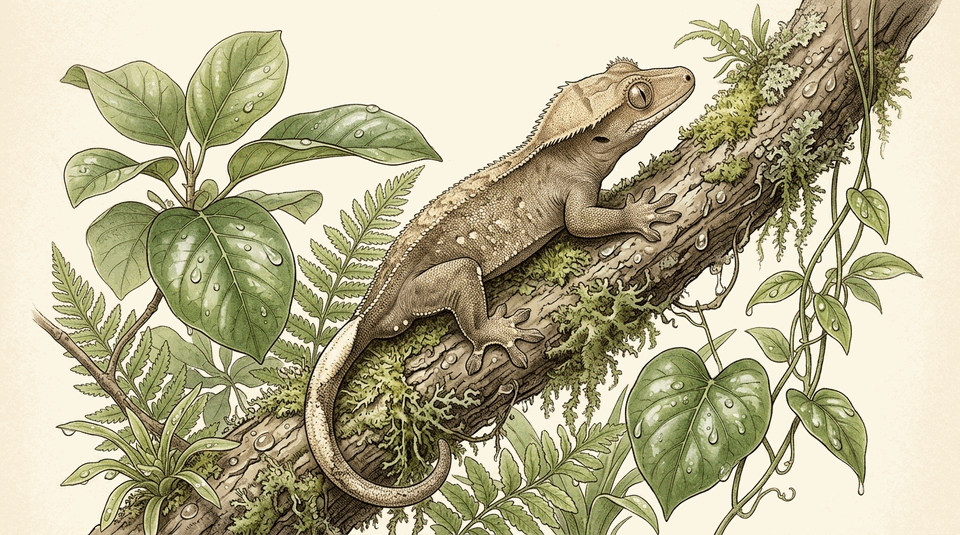
Crested Gecko
Correlophus ciliatus
1. Tall Jungle Setup & The Mist-and-Dry Cycle

2. Two Great Ways to Set Up Your Habitat
Bioactive Jungle vs. Simple Setup
Crested Geckos spend 90% of their life up off the floor in branches and leaves:
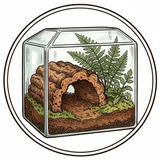
Option A: Live-Planted Bioactive Tank
Drainage balls, tropical soil, leaf litter, sturdy live Pothos/Schefflera plants, and springtails + one isopod kind that likes a humid tank that eat poop and mold for you (we'll help you pick)!
Option B: Simple Cork & Silk Vine Setup (Great for Babies)
Damp paper towels for tiny babies (so you can make sure they're pooping!) or coco/soil bedding, packed top-to-bottom with cork tubes and fake vines.
Low-Level UVB vs. Standard LED
Because powdered Complete Gecko Diet already has Vitamin D3 mixed right in, you can go either route:
Option A: 5%–7% Shade UVB + Plant LED
An optional, gentle UV boost that also helps live plants grow.
Option B: Simple Day/Night LED Light
As long as they're eating quality Complete Gecko Diet (CGD) and calcium-dusted bugs, a regular low-heat LED light works great.
Do You Need a Heat Bulb?
Big No-No: overheating above 82°F is way more dangerous to Crested Geckos than being a little cool!
Option A: Normal Heated House (72–78°F)
Skip heat lamps completely! Normal indoor room temperatures are right in their sweet spot.
Option B: Chilly Winter Room (Below 65°F)
Use a tiny 25W–40W nano ceramic heat emitter or low-watt bulb on a thermostat set to 75°F.

3. Feeding Guide: Fruit Smoothie Cups + Weekly Bugs
Favorite Flavors & Bugs on Our Shelves:
Fig & Insect, Growth/Breeding, Fruit w/ Bugs
Watermelon, Apricot, Papaya, Banana
Triggers their hilarious nocturnal pounce
Keep food up high where they actually hang out!

4. Four Keys to a Happy, Thriving Crested Gecko
Let It Dry Between Mists
Keeping the tank sopping wet 24/7 grows mold and causes skin/breathing issues. Mist well at night (80–90%), then let it air out to 50–60% during the afternoon!
Pack the Top 70% Full
Give them plenty of horizontal branches and vines across the top half of the tank. If they sleep hanging upside-down on bare glass every day, their tail weight can bend their hips ('Floppy Tail').
'Frog-Butt' Tail Fact
Unlike Leopard Geckos, if a Crested Gecko drops its tail when spooked, it never grows back! Almost all wild adults are cute 'frog-butts' and live totally normal, happy lives.
Treadmill Hand-Walking
Crested Geckos are jumpers! Sit over a bed or couch and let them hop from one flat hand to the other like a little treadmill—never squeeze them.

Bring-Home Shopping Checklist
Tap items to check them off on your phone while you shop at Gresham Pet Supply.
Tall Terrarium & Canopy Clutter
Misting, Soil & Lighting
Smoothie Diet & Live Bugs
Complete Reference Notes & Oregon Keeping Guide
Housing & Enclosure
Enclosure Type & Size
- Type: Glass front-opening terrarium with a screen top for ventilation.
- Orientation: Arboreal (vertical). Height is far more important than width.
- Minimum for Adults: 18" x 18" x 24" for a single adult over 20 grams.
- Recommended for Adults: 18" x 18" x 36" (taller is always better).
- Minimum for Babies: A small 12" x 12" x 18" enclosure or a ventilated plastic tub (like a Kritter Keeper). Babies put in massive tanks often fail to find their food and starve.
Substrate
- Hatchlings/Quarantine: Paper towels are highly recommended to easily monitor bowel movements and prevent impaction if they miss a bug.
- Adults: Coconut fiber (Zoo Med Eco Earth), orchid bark, or a bioactive soil mix.
- Bioactive Option: Excellent choice. A mix of ABG soil, leaf litter, isopods, and springtails works wonderfully in the humid crested gecko environment.
Décor & Enrichment
- Climbing: Fill the tank! Crested geckos need horizontal and diagonal branches, cork bark tubes, and vines to jump and rest on. A bare tank causes stress and physical deformities (like Floppy Tail Syndrome).
- Hides: Hanging coconut hides, magnetic ledges, and dense foliage (live or fake plants like Pothos or fake vines).
- Feeding Ledge: A magnetic or suction-cup feeding ledge placed high up in the tank is essential, as they prefer to eat up high, not off the ground.
Temperature
CRITICAL WARNING: Crested geckos cannot tolerate heat! Temperatures over 82°F (28°C) can cause rapid heat stroke and death.
| Zone | Temperature |
|---|---|
| Daytime Ambient | 72–78°F (22–25°C) |
| Maximum (CRITICAL) | Keep under 80°F (27°C). Above 82°F (28°C) is fatal |
| Nighttime Drop | 65–72°F (18–22°C) |
Heating
- Primary: Room temperature is usually perfect. If your house stays between 70-75°F, you do not need a heat lamp.
- Secondary: If your house drops below 65°F in winter, use a very low-wattage Ceramic Heat Emitter (CHE) or a small heat mat on the side of the glass, controlled by a thermostat set to 75°F.
- (cross-ref: Reptile/Amphibian Heating)
Humidity
- Target Range: 50–70% base, spiking to 80%+ when misted.
- How to Maintain: Mist the enclosure heavily every evening.
- The "Dry Out" Period: The enclosure MUST be allowed to dry out to around 50% during the day. If the tank is constantly soaking wet 24/7, the gecko will develop respiratory and bacterial skin infections.
Lighting
- Photoperiod: 12 hours on / 12 hours off (natural room light is often enough).
- UVB: Not strictly required, as their dietary needs are met via fortified powders. A low-output UVB lamp made for shade-dwelling geckos (such as Arcadia ShadeDweller) is an optional upgrade. Never a desert-strength bulb. Make sure it doesn't overheat the tank.
Diet & Nutrition
Primary Diet: Crested Gecko Diet (CGD)
- The staple diet is a commercial powdered mix that you mix with water to the consistency of ketchup or a smoothie.
- Brands We Recommend: Pangea, Repashy, or Zoo Med Crested Gecko Diet.
- Frequency: Offer fresh CGD every 1 to 2 nights, in the evening. Remove uneaten food after 24 hours to prevent mold.
- Serving Size: Just enough to cover the bottom of a small feeding cup. They have tiny stomachs!
Live Insects (Optional but Recommended)
- Offering live insects 1-2 times a week stimulates natural hunting behavior and promotes faster growth.
- Prey: Crickets or small Dubia roaches. (No mealworms or superworms—their hard exoskeletons can cause impaction).
- Size Rule: Insects should be no longer than the space between the gecko's eyes.
- Dusting: Dust insects with calcium every time. Use calcium with D3 (such as Zoo Med Repti Calcium with D3) at most feedings, plus a multivitamin about once a week, and follow the label on the powder.
Water
- Geckos will mostly drink the water droplets off the glass and plant leaves after you mist the enclosure.
- Provide a small, shallow water dish on their feeding ledge, changed daily.
Health & Husbandry

Common Health Issues
- Metabolic Bone Disease (MBD) — Symptoms: Soft jaw, kinked/wavy tail, tremors, unable to stick to glass. / Cause: Feeding only baby food or fruit instead of complete CGD, or lack of calcium. / Prevention: Only feed Repashy/Pangea/ZooMed CGD and dust insects with calcium.
- Stuck Shed — Symptoms: Retained skin on the toes (looks like little white socks) or tail tip. / Cause: Humidity too low. / Treatment: Do not pull dry skin. Raise the humidity at the next misting. If shed stays stuck on the toes or tail tip, see a vet who sees reptiles.
- Floppy Tail Syndrome (FTS) — Symptoms: The tail flops over at a 90-degree angle when the gecko is resting head-down on the glass. / Cause: Lack of horizontal resting branches, causing them to sleep vertically on the glass. / Prevention: Clutter the tank with lots of horizontal/diagonal branches and cork bark.
Tail Dropping (Autotomy)
- Crested geckos can drop their tails if they are terrified, grabbed by the tail, or highly stressed.
- Unlike leopard geckos, crested geckos DO NOT grow their tails back. They heal perfectly fine and live normal, happy lives as "frog butts." It is purely a cosmetic loss.
Veterinary Needs
- Crested geckos are incredibly hardy when fed properly. Seek an exotic vet if you notice severe weight loss, lethargy, or signs of MBD.
Morphs & Varieties
Crested geckos are highly variable. Most patterns are "polygenic," meaning they are selectively bred for a look rather than a single predictable gene.
Common Patterns / Traits
- Patternless: Solid color (red, olive, yellow, dark brown) with no patterning.
- Flame: A base color with a contrasting, brighter color running only down the back (the dorsal).
- Harlequin: Similar to a Flame, but the contrasting color heavily creeps up the sides and legs.
- Pinstripe: Cream-colored raised scales forming two distinct, solid lines down the edges of the back.
- Dalmatian: Black or red ink-like spots scattered across the body. Can occur on any base morph.
- Lilly White: A true genetic morph. Features striking, bright white sides, belly, and dorsal.
Handling Guidelines
- "The Hand Treadmill": Crested geckos move by walking and jumping. Hold one hand in front of the other and let them walk forward.
- Jumping: They are excellent jumpers. Keep them close to the floor, over a bed, or over a table when handling to prevent long falls.
- Flighty Babies: Hatchlings and juveniles are extremely fast and skittish. Keep handling short until they grow and calm down.
- The Tail Rule: NEVER grab or pinch the tail.
Compatibility
- Cohabitation: Strictly solitary. Males will fight to the death. Females often bully each other for food and the best hiding spots. Keep them housed individually to ensure a stress-free life.
Oregon & Local Keeping Notes
- Oregon: Questions about permits or the law? Ask a store manager.
- General: Widely captive-bred. Though they were once thought to be extinct in the wild (rediscovered in 1994), they are now one of the most heavily captive-bred reptiles in the world.
What We Stock & Use in Our Stores
These are products we carry and recommend for this species. Ask any associate for help finding them in-store.
| Category | Product | Notes |
|---|---|---|
| Enclosure | Exo Terra Glass Terrarium 18x18x24 | Minimum for adults |
| Substrate | Zoo Med Eco Earth | Holds humidity perfectly |
| Diet | Repashy or Zoo Med Crested Gecko Diet | The staple food source |
| Feeding Station | Magnetic Feeding Ledge & Cups | Keeps food off the ground |
| Hydration | Exo Terra Mister | For daily evening misting |
| Temperature/Humidity | Exo Terra Digital Thermo-Hygrometer | Monitor humidity spikes and dry-outs |
| Hides | Zoo Med Cork Bark Tubes | Essential for hiding and climbing |
| Foliage | Exo Terra Hanging Silk Plants (Large) | Provides cover and drinking surfaces |
| Supplements | Zoo Med Repti Calcium with D3 | Dust on live insects only |
| Optional Heat | Zoo Med Ceramic Heat Emitter (25W-40W) | ONLY if room is below 65°F (use thermostat) |
Last updated: 2026-08-04
How We Keep Them at Critter Cabana & Gresham Pet Supply
- Beating Dry Oregon Furnace Air (and Summer Heat Spikes): Across the Willamette Valley and Portland Metro, running the house furnace all winter drops indoor humidity to 25–35%, which quickly causes stuck sheds and dehydration in screen-top tanks. To hold
50-80%reliably for Crested Gecko, our crew mists heavily every evening and lets the enclosure dry out to around 50% during the day, with a moisture-holding substrate and partial screen cover when needed. - Thermostat & Linear UVB Standard: Every heating element in our Newberg and Gresham reptile rooms runs on a thermostat. Our Crested Geckos get no basking lamp. We keep their room at 72–78°F and always under 80°F.
- Shopping at Newberg & Gresham: For enclosures, thermostats, UVB lighting, bioactive supplies, springtails, isopods and feeders at Critter Cabana (Newberg) and Gresham Pet Supply, ask us what we have in store today.
Common Questions (FAQ)
What size tank does an adult Crested Gecko actually need?
An adult Crested Gecko needs at least 18x18x24 inches (18x18x36 preferred) with lots of branches and cover. They don't need a basking spot. Keep the room at 72–78°F and always under 80°F.
How do I keep Crested Gecko humidity at 50-80% during dry Oregon winters?
Oregon winter furnace heat dries the air out fast. Mist heavily every evening, use a moisture-holding substrate such as coconut fiber, and cover part of an open screen top if humidity drops too low. Let the enclosure dry out to around 50% during the day.
What is the best bioactive clean-up crew for a Crested Gecko?
Pair springtails with one isopod kind matched to your tank's humidity in a 3–5 inch bioactive soil and leaf-litter bed. We'll help you pick an isopod kind that suits your tank's climate, and pick one isopod kind per build. Our 1-Page or Tri-Fold Bioactive Substrate Recipe Guide covers the rest.
Where can I get Crested Gecko setup supplies, live feeders, and thermostats in Oregon?
Ask us what we have in store today at Critter Cabana in Newberg (514 E First St, 503-537-2887) and Gresham Pet Supply (2185 NW Burnside Rd, 503-665-7606).
Shop supplies for this animal
Everything for your Crested Gecko setup, ready for pickup in store or shipped to you.