
Bioactive Setup
What is a Bioactive Enclosure?
A bioactive enclosure is a self-sustaining miniature ecosystem. Instead of sterile paper towels or artificial turf that must be constantly replaced, a bioactive setup uses living soil, live plants, and a "Clean-Up Crew" (micro-invertebrates) to break down animal waste (feces, shed skin, uneaten food) and convert it into nutrients for the plants.
The Goal: To replicate nature. While it requires more effort and cost upfront, a properly functioning bioactive enclosure smells earthy and fresh, requires far less cleaning, and provides massive mental enrichment for your animal.
The 4 Essential Layers
Building from the bottom up ensures proper drainage and prevents the soil from turning into a swamp.
1. The Drainage Layer (False Bottom)
- Purpose: To catch excess water from misting or watering plants, keeping the soil above it from becoming waterlogged (which causes root rot and bacterial blooms).
- Materials: LECA (Lightweight Expanded Clay Aggregate, often sold as Hydroballs), lava rock, or plastic egg crate.
- Note for Arid Setups: In very dry enclosures (like for a Bearded Dragon), a drainage layer is usually unnecessary since you won't be heavily watering.
2. The Barrier Layer (Substrate Mesh)
- Purpose: A physical barrier to prevent the soil layer from falling down into the drainage layer and clogging it.
- Materials: Fiberglass window screen mesh, weed blocker fabric, or specialized terrarium mesh.
- Application: Cut to the exact footprint of the tank and lay it flat over the drainage layer.
3. The Substrate Layer (The Soil)
- Purpose: To anchor the plants, hold moisture, and house the clean-up crew. It must be light, airy, and nutrient-dense.
- Materials:
- Tropical (Frogs, Crested Geckos): ABG (Atlanta Botanical Gardens) mix, or a blend of organic topsoil, sphagnum moss, orchid bark, tree fern fiber, and horticultural charcoal.
- Arid (Bearded Dragons, Leopard Geckos): A drier bioactive mix with no fertilizer or added chemicals.
- Depth: Depends on the animal and the build. Check your animal's care sheet or ask our team. Burrowers and big-rooted plants need more.
4. The Leaf Litter Layer
- Purpose: This is the most critical layer for the Clean-Up Crew. Leaves provide a micro-climate where isopods and springtails can hide, breed, and eat. As the leaves decay, they become food.
- Materials: Dried, sterilized Live Oak, Sea Grape, Magnolia, or Indian Almond leaves.
- Application: Cover the entire floor of the terrarium (especially for amphibians, as it keeps the soil off their skin).
The Clean-Up Crew (CUC)
The CUC are the unsung heroes of the bioactive tank. They eat the mold, fungus, and animal waste.
Springtails
- What they do: Microscopic white insects that eat mold, fungus, and bacteria. They are the primary defense against terrarium rot.
- Environment: They thrive in high humidity and moisture. In arid tanks, they will stick to the damp soil underneath the water bowl.
Isopods (Roly-Polys / Woodlice)
- What they do: Larger detritivores that act as the heavy lifters, eating solid waste (feces, dead leaves, shed skin).
- Which species to choose?
- Match the climate: Some isopod kinds like a humid tank and some handle a drier one (they still need a damp hide). We'll help you pick an isopod kind that suits your tank's climate, and pick one isopod kind per build.
- Avoid: Do not use massive, hard-shelled isopods for delicate animals, as they can sometimes nibble on resting reptiles.
IMPORTANT: Your animal will occasionally eat the CUC. This is normal and provides a healthy, natural hunting experience. The crew gets topped up over time. If it keeps disappearing, ask us. That usually points to a moisture or food problem.

Plants & Lighting

Choosing Plants
Select plants that match your animal's environment and destructiveness.
- Heavy/Destructive Reptiles (Ball Pythons, Monitors): Sturdy plants like Snake Plants (Sansevieria), Pothos, or large bromeliads mounted on the walls.
- Delicate Amphibians/Geckos: Ferns, creeping figs (Ficus pumila), and delicate bromeliads.
- Arid Setups: No live plants by default. Air plants and spineless succulents are the exception.
Lighting for Plants
Your reptile may need UVB, but your plants need a full-spectrum white plant light to grow.
- Use high-quality LED plant lights (like Fluval Plant Nano, Jungle Dawn, or Arcadia LumenIZE).
- Standard room lighting or purely UVB lighting is not strong enough to keep live plants alive.
Maintenance & Best Practices

- The Cycling Period: After building the tank, add the plants and CUC. Let the enclosure settle before adding your animal. Ask us how long to wait. Longer is fine; sooner is not. This gives the plants time to root and the CUC time to breed. If you put a hungry reptile in on day one, it will trample the unrooted plants and eat all the isopods.
- Spot Cleaning: A bioactive tank is not "no maintenance." You must still spot-clean large pieces of feces that the isopods cannot break down quickly enough.
- Feeding the CUC: If your animal is small and doesn't produce much waste, you must feed your CUC! Drop in a small piece of squash, carrot, or isopod food, only what the crew clears quickly. Leftover food in damp soil grows mold and draws mites and fungus gnats.
- Watering: Water the plants at the roots, but don't flood the tank. If the water level in the drainage layer reaches the soil mesh, use a siphon or turkey baster to suck the excess water out.
What We Use & Recommend
These are products we use and recommend for building bioactive setups. Stock varies by store, so ask us what we have in store today.
| Category | Product | Notes |
|---|---|---|
| Enclosure | Exo Terra Natural Terrarium / Zilla Micro Habitat | Essential front-opening access |
| Substrate | Zilla Jungle Mix (Tropical) or Zilla Desert Mix (Arid) | High-quality base for soil mixing |
| Moss/Moisture | Zilla Frog Moss or Exo Terra Forest Moss | Mix into substrate to retain humidity |
| Decor & Hides | Zilla Rock Lair / Exo Terra Caves | Rock Lair creates a perfect humid hide for CUC |
| Lighting | Exo Terra Compact Top / Zilla Pro Sol | Fixtures for plant grow bulbs and UVB |
| Humidity Control | Exo Terra Fogger or Rain System | Essential for tropical bioactive tanks |
Last updated: 2026-08-04
Naturalist Bioactive Substrate & Cleanup Crew Visual Guide
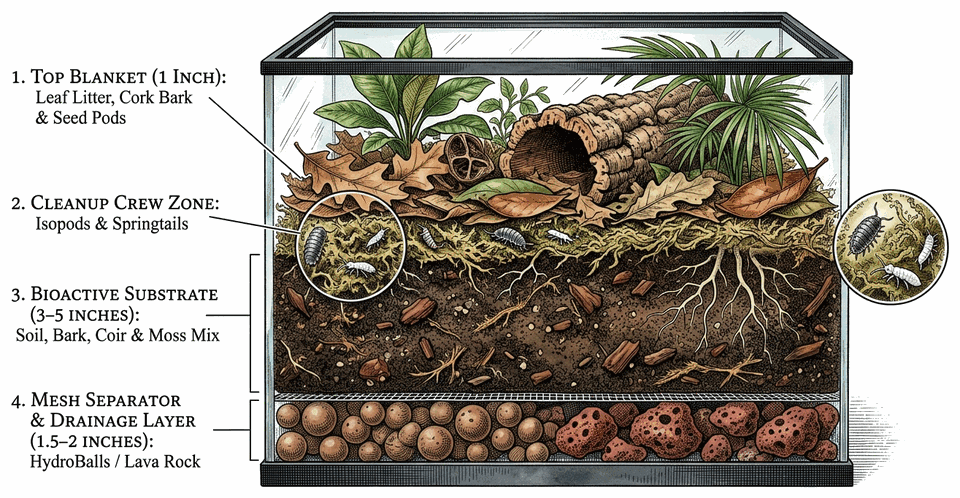
Store-Shelf Bioactive Substrate Recipes (10-Part Scoop Formulas)
Use any cup or scoop as "1 Part" to mix these exact store-shelf formulas at home:
1. Tropical & Forest Bioactive Mix (Moisture-Holding)
For Crested & Gargoyle Geckos, Dart Frogs, White's Tree Frogs, Ball Pythons, Rainbow Boas, Cuban False Chameleons & Tropical Plants
- 4 Parts — Zoo Med Reptisoil (humus, peat, sand & carbon base)
- 3 Parts — Zoo Med ReptiBark OR Forest Floor Cypress Mulch (creates air pockets so soil never packs into mud)
- 2 Parts — Zoo Med Eco Earth (Loose Coconut Fiber) (holds moisture evenly)
- 1 Part — Zoo Med New Zealand Sphagnum Moss (chopped and mixed in for humid micro-pockets)
- Underlayer: 1.5"–2" Zoo Med HydroBalls (or washed pea gravel) + Pangea / ReptiSafe Terrarium Mesh separator screen
- Top Blanket: 1" Seed Pods & California Vivarium Supply (
CVS#306646) Black Oak / Magnolia Leaf Litter - Clean-Up Crew: Springtails plus one isopod kind that likes a humid tank. We'll help you pick an isopod kind that suits your tank's climate.
2. Arid & Desert Bioactive Mix (Drier Mix)
For Leopard Geckos, Bearded Dragons, Uromastyx, Western Hognose Snakes, Corn Snakes & Arid Tarantulas
- 5 Parts — Zoo Med Reptisoil (holds burrow moisture beneath a dry surface)
- 3 Parts — Zoo Med ReptiSand OR Exo Terra Stone Desert (true natural quartz sand — never use calcium sand!)
- 1 Part — Zoo Med Excavator Clay Burrowing Substrate (binds tunnels so burrows hold their shape)
- 1 Part — Sphagnum Moss / Cypress Mulch (tucked into the lower layer & under the water dish as a moist oasis)
- Underlayer: No HydroBalls needed for arid tanks. Pour the mix directly onto the tank floor, as deep as your animal's care sheet calls for.
- Top Blanket: Flat Cork Bark Slabs, Slate Basking Stones & Crushed Dry Oak Leaf Litter
- Clean-Up Crew: Springtails (with a damp moss oasis under cork bark) plus one isopod kind that handles a drier tank. We'll help you pick an isopod kind that suits your tank's climate.
3. Millipede, Isopod & Burrowing Invert Mix
For Giant Millipedes, Isopod Display Colonies, Terrestrial Tarantulas & Asian Forest Scorpions
- 5.5 Parts — Zoo Med Reptisoil (100% pesticide-free, fertilizer-free humus base)
- 2 Parts — California Vivarium Supply (
CVS#879112) Rotting Hardwood (their #1 daily food source!) - 1.5 Parts — California Vivarium Supply (
CVS#306646) Black Oak Leaves & Zoo Med Leaf Litter (crushed into the dirt and layered on top) - 1 Part — CaribSea Reptilite (
#007100Natural Aragonite Calcium Sand) (slow-release calcium carbonate they eat to build thick exoskeletons after molting!) - Clean-Up Crew: No isopod is 100% molt-safe. Keep millipedes on their own, with no clean-up crew, and use springtails only around molting tarantulas and scorpions. For an isopod colony, pick one isopod kind per build.
Picking Your Clean-Up Crew
- Springtails eat mold and fungus and suit most humid builds.
- Isopods eat the bigger waste. We'll help you pick an isopod kind that suits your tank's climate. Pick one isopod kind per build.
- Around molting pets: big, hungry isopods can nibble a molting tarantula, scorpion or millipede. Keep millipedes on their own, and use springtails only around molting tarantulas and scorpions.
How Many Bags Should I Buy? (Check your animal's care sheet for the depth)
| Common Enclosure Size | Total Volume Needed | What to Grab on the Shelf |
|---|---|---|
| 10-Gal / 12"×12" Base (Inverts, Isopods, Slings) | ~10–12 Quarts | 1× 10qt Reptisoil + 1× 4qt ReptiBark + 1× Leaf Litter |
| 18"×18" Base / 20-Gal Long (Crested Gecko, Dart Frog) | ~20–25 Quarts | 1× 24qt Reptisoil (or 2× 10qt) + 1× 8qt ReptiBark/Eco Earth (+ 2 bags HydroBalls if tropical) |
| 40-Gal Breeder / 36"×18" Base (Ball Python, Bearded Dragon, Corn Snake) | ~45–55 Quarts | 2× 24qt Reptisoil + 1× 24qt ReptiBark (or 2× 10lb ReptiSand for Arid) |
(Note: Hermann's & Mediterranean Tortoises need a large Tortoise Table or Outdoor Pen with damp-underneath soil/cypress, not an arid glass tank.)
Which Sand Bag Should I Grab? (Our Store Recommendations)
| Store Sand Product | Mineral Type | Our Store Recommendation |
|---|---|---|
Zoo Med ReptiSand (#760101 Desert White / Red) | 100% Pure Quartz / Silica | Recommended for Reptile Bioactive Mixes — holds burrows & never clumps when misted |
Exo Terra Stone Desert (#231398 / #231367) & ZM Excavator Clay (#740103) | Natural Silica Sand & Clay | Recommended for Sculpted Desert Burrows |
CaribSea Reptilite (#007100 Natural Aragonite) | 100% Calcium Carbonate | Recommended for Isopod & Millipede Mixes (even though the bag pictures reptiles, we prefer quartz for reptiles and use Reptilite as a 10% shell-building calcium boost in Isopod/Millipede dirt!) |
How We Keep Them at Critter Cabana & Gresham Pet Supply
- Store-Shelf 10-Part Bioactive Recipes (Tropical, Arid & Invert): In our reptile rooms at Critter Cabana (Newberg) and Gresham Pet Supply, we build every bioactive vivarium from the bottom up. Tropical builds start with a drainage layer of clay balls, then a mesh barrier, then a soil, bark and moss blend, then a thick top blanket of dry oak or magnolia leaf litter. Very dry desert builds often skip the drainage layer.
- Springtails & Isopods for Seeding: Ask us what we have in store today. We'll help you pick an isopod kind that suits your tank's climate, and pick one isopod kind per build.
- Grab Our Printable 1-Page Recipe or Tri-Fold Brochure: Ask our reptile team to help you size the mix for your tank.
Common Questions (FAQ)
How deep should the soil layer be in a bioactive terrarium?
It depends on the animal and the build, so check your animal's care sheet or ask our team. Burrowers and big-rooted plants need more depth. Top it with a generous layer of leaf litter and cork bark flats.
Do arid bioactive setups (like Leopard Geckos or Bearded Dragons) need a drainage layer?
Usually no—in arid setups where you are not misting heavily, skip the LECA drainage layer and instead create a deep moisture gradient by watering only the cool/humid hide corner so isopods and springtails have a damp underground retreat.
Which isopods should I pick for a tropical vs. arid bioactive tank?
Pick one isopod kind per build, matched to the tank: a kind that likes it damp for humid tropical tanks, or one that handles dryness for semi-arid setups (with a damp sphagnum moss pocket under cork bark). Pair it with springtails. We'll help you pick an isopod kind that suits your tank's climate.
Where can I buy bioactive soil ingredients, cork bark, and live isopods in Oregon?
Ask us what we have in store today at Critter Cabana in Newberg (514 E First St, 503-537-2887) and Gresham Pet Supply (2185 NW Burnside Rd, 503-665-7606).
Shop supplies for this animal
Everything for your Bioactive Setup setup, ready for pickup in store or shipped to you.